

In Outlook 2010, the Auto-Complete List file (.nk2) is discontinued.One of the great things about online email services like Gmail is that you never have to worry about things like autocomplete, because all your contacts are stored in the cloud, and Gmail automatically creates a giant index of everyone who sent an email to you, or everyone you email. Windows XP drive:\Documents and Settings\user\Application Data\Microsoft\Outlook. In Outlook 2007, the Auto-Complete List file (.nk2) is stored in the following locations: Windows Vista drive:\Users\user\AppData\Roaming\Microsoft\Outlook.
Here’s the rules for finding the location of your NK2 file: For Outlook 2003/2007 with Windows 2000, Windows XP, or Windows Server. The location of the NK2 AutoCompelete file created by Outlook might be different from one computer to another, depending on the operating system and the version of Outlook. I moved the nk2 files from their PC and put them onto the file server where their roaming profiles are saved.The location of the NK2 file of Outlook.
Nk2 File Location How To Transfer AutoComplete
I also ran into an issue where autocomplete would work for one Outlook session, but when you close it and reopen it all the entries are gone.In this article, I will share several methods that I have learned over the years to fix the Autocomplete issue in Outlook and how to transfer AutoComplete suggestions from one Outlook to another.A common issue where autocomplete stops working has something to do with your PST file. If you work in a corporate environment, then technically your contacts are stored in the cloud (Exchange server).If you’ve been using Outlook for years, your autocomplete database can be huge, and if it suddenly stops working, emailing someone is a real problem! Sometimes AutoComplete stops working due to problems with the PST file, and sometimes due to updating to a newer version of Outlook from previous versions. Basically, every time you enter a name or email address in Outlook, it saves it to a file, and so the next time you enter that name or email address, it fills it in automatically.Where is the contacts folder in outlook 2013 Import contacts to Outlook support.microsoft.com Where are Outlook Contacts stored Standardize Contacts Full.Note. The same is true for the autocomplete suggestion feature. Nothing is stored in the cloud, so everything is based on local files.
Nk2 File Location Download Their FixIT
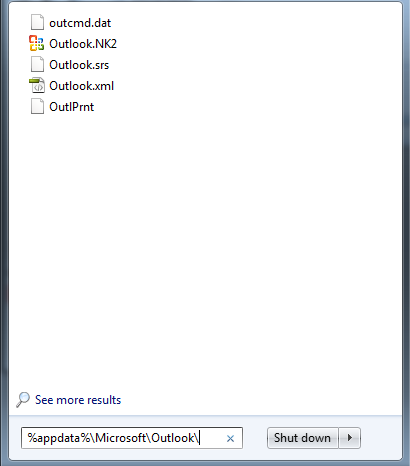
If you want to do it yourself, you can find the file in the following location for Outlook 2003/2007 running Windows 2000 or XP:C: Documents and Settings Username Application Data Microsoft OutlookFor Outlook 2003/2007 running Windows Vista or 7:C: Users Username AppData Roaming Microsoft OutlookNow, to import it into Outlook 2010, you need to make sure the NK2 file is in this directory:Finally, click the Start button, type Run, and in the Open dialog box, type the following command:This should import the name cache from an older version of Outlook into Outlook 2010.In some cases, in order for this to work again in Outlook, you may need to clear the autocomplete cache. You can download their FixIT program and just select the NK2 file and it will do the rest for you. Outlook 2010 stores it differently, so you need to import this file if you are trying to get offer data from an older version of Outlook in Outlook 2010.Check out the Microsoft KB article above on how to do this. By default, it should be named Outlook.pst.If you see that the repair tool has fixed some problems with the PST file, then you are probably in luck and autocomplete should work fine again, especially if it was reset every time you closed and opened Outlook.All versions of Outlook prior to 2010 saved this name / email address in a file with an NK2 extension.
You just need to rename the RoamCache folder to something else and Outlook will create a new one when you start the program again.C: Users Username AppData Local Microsoft Outlook RoamCacheC: Documents and Settings Username Local Settings Application Data Microsoft Outlook RoamCacheEven though Outlook 2010/2013/2016 doesn’t have a specific NK2 file, they still store information in a file, but with a different name. Try entering multiple email addresses, then exit Outlook and reopen it and check if the names are still there.You can also get rid of the current cache completely and start from scratch, which might be the only way to fix the problem. Exit Outlook and check the box again. It’s also a good idea to deselect the Use AutoComplete List checkbox to suggest names as you type in the To, Cc, and Bcc fields. Then click on “Mail” and scroll down to the “Send Mail” section.Click the Clear AutoComplete List button.
Dat file with NK2Edit and then close it. If you just had this problem, you may be able to recover some of the suggested names by opening this Stream.dat file with a program called NK2Edit:Http: //The first thing you can try is to simply open the. In Method 4, we renamed this RoamCache folder, but this deletes everything and forces you to start from scratch.
You don’t have to select all contacts if you don’t want to. NK2 File.Then go to Actions and select Add Address Book Entries.Now select the contact you want to use to create a new NK2 file. You can do this by opening NK2Edit and choosing File – New. You should immediately see the autocomplete list:If it doesn’t open or you can’t open it manually, then you need to create a new cache file and replace the current stream.dat file. Note that this program will automatically detect if you have Outlook installed and will download the cache file for you if it is stored in the default folder. Then open Outlook and see if that fixed the problem.
This is it! It’s a long process, but it works! And now you know how to completely fix and edit the autocomplete list yourself if you want!You can also get a lot more information about Outlook AutoComplete on the Microsoft support website. Dat instead of NK2.For the filename, simply select the current file you will be replacing. If not, just select Contacts and then Control and click to select individual contacts.Now execute the “File – Save As” command, navigate to the location of the current cache file (stream_autocomplete) and change the “Save As” type to.
 0 kommentar(er)
